For over two centuries, the U.S. one-cent coin has been more than just pocket change. It has served as a miniature canvas for American history, a reflection of economic shifts, and a piece of everyday life for millions. From palm-sized copper discs to the modern zinc-based penny, the cent has mirrored the nation’s journey in both design and purpose.
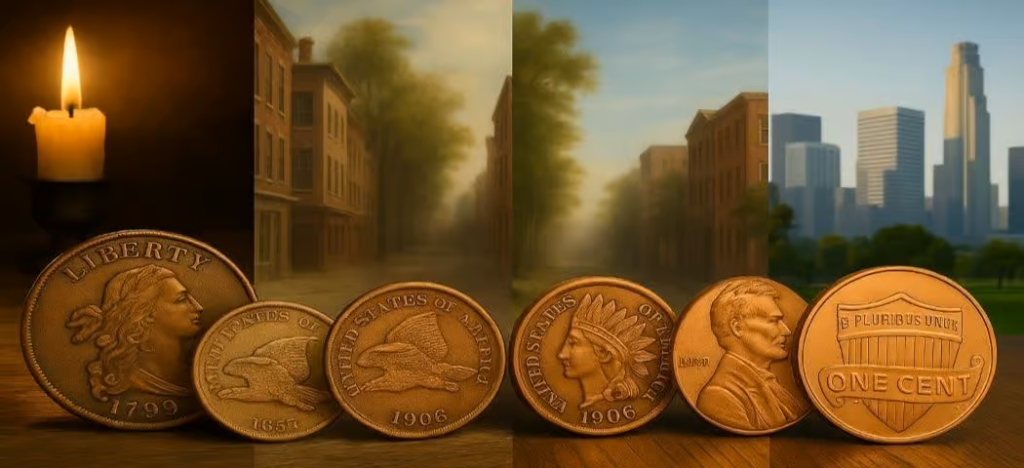
Despite its low face value, the penny holds an outsized place in U.S. culture and collecting. It’s the coin most Americans encounter first — slipped into a child’s piggy bank, pressed into a “lucky penny” for good fortune, or spotted in a parking lot with the old saying, “Find a penny, pick it up…” Certain issues — like the 1909-S VDB, the rare 1943 copper cent, and notable double die varieties — can be worth hundreds or even thousands of dollars.
For many numismatists, the penny is a “gateway coin” — a starting point for a lifelong collecting journey. Affordable and abundant in circulation, it offers the thrill of discovery, whether pulling a wheat cent from pocket change or filling out a Whitman folder. Beyond collecting, it’s a cultural icon that has sparked debates over whether it should remain in production at all.
Large Cents (1793–1857)
Flowing Hair Liberty (1793)
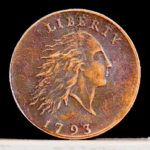
The very first U.S. cents were pure copper and much larger than today’s coins, often called “large cents.” The debut Flowing Hair Liberty featured a chain reverse symbolizing unity, but the public disliked the imagery, finding it too reminiscent of slavery. This led to a quick redesign with a wreath reverse within the same year. Collectors prize these coins for their historical importance and the fact that they represent the starting point of U.S. coinage. Surviving examples — especially in high grade — are rare and command strong prices.
Liberty Cap and Draped Bust Designs (1793–1807)
The Liberty Cap design, inspired by the Phrygian cap of freedom, and the later Draped Bust series reflected neoclassical art popular at the time. Subtle modifications in details, such as the curve of Liberty’s hair or lettering style, keep collectors engaged in assembling complete type sets. Many examples circulated heavily in their day, making well-preserved pieces even more desirable.
Did You Know? Some early U.S. cents were so big and heavy that merchants in the 1800s jokingly called them “whoppers.” Measuring 29 mm across — about 19% larger than today’s 24.3 mm Washington Quarter — these hefty coins made quite an impression both in the hand and in the pocket.
Classic Head and Braided Hair (1808–1857)
The Classic Head cents had a smaller, more delicate Liberty portrait, while the Braided Hair series introduced a sleeker design with more refined engraving. By the 1850s, rising copper prices and the impracticality of large, heavy cents prompted the shift to a smaller coin. Collectors enjoy these series for their relative affordability compared to earlier large cents and for the historical context of a changing U.S. economy.
Small Cents (1856–1909)
Flying Eagle Cent (1856–1858)
The introduction of the copper-nickel alloy made smaller cents possible, beginning with the Flying Eagle design. The eagle was inspired by the Gobrecht silver dollars of the 1830s, but the high-relief design made striking difficult, leading to its quick replacement. Today, the short production run — especially the 1856 pattern issue — makes these cents highly sought after, with some examples commanding thousands at auction.
Did You Know? The Flying Eagle Cent was America’s first small-sized cent, but its high-relief design wore down the dies quickly, forcing the Mint to scrap it after just three years.
Indian Head Cent (1859–1909)
Beloved for its distinctive design, the Indian Head cent featured Liberty wearing a Native American headdress — a nod to the romanticized imagery of the era. Early issues were copper-nickel, switching to bronze in 1864. With a 50-year run, the series offers variety for collectors, from common dates ideal for beginners to key rarities like the 1877 issue. The coin also carries Civil War-era history, making it a favorite for both numismatists and historians.
Did You Know? The Indian Head Cent doesn’t depict a Native American — it’s Lady Liberty wearing a feathered headdress, modeled after engraver James B. Longacre’s daughter.
Lincoln Cents (1909–Present)
Wheat Reverse (1909–1958)
In 1909, the cent made history as the first U.S. coin to depict a real person — Abraham Lincoln — in honor of his 100th birthday. The reverse’s two stylized wheat stalks symbolized prosperity and agriculture. Collectors often begin their Lincoln sets with the Wheat Penny series, drawn by popular key dates like the 1909-S VDB and 1914-D.
Did You Know? The famous “VDB” initials on the 1909 Lincoln Cent belong to designer Victor David Brenner. Their bold placement on the coin’s reverse caused such a stir among the public and Treasury officials that they were quickly removed, making those first-issue pieces a short-lived rarity treasured by collectors today.
Lincoln Memorial Reverse (1959–2008)
To mark Lincoln’s 150th birthday, the reverse was updated to showcase the Lincoln Memorial, complete with a tiny statue of Lincoln visible between the columns — a detail that fascinates many collectors. This design spans almost five decades, producing varieties and errors that keep the series interesting for specialists.
Did You Know? If you look closely at the Lincoln Memorial on the reverse, you can see a tiny engraved statue of Lincoln between the columns — visible only under magnification.
Bicentennial Designs (2009)
Four unique reverse designs were struck for just one year to celebrate Lincoln’s 200th birthday, each depicting a different stage of his life. These limited-run designs were a hit with collectors, many of whom saved them from circulation immediately.
Union Shield (2010–Present)
Symbolizing Lincoln’s preservation of the Union, the Union Shield reverse remains in production today. The design’s clean, bold appearance makes modern examples ideal for illustrating the evolution of U.S. coinage to new collectors, while error hunters enjoy searching for modern minting anomalies.
Shifts in Composition: Economics and Metal Supply
The penny’s material has changed multiple times, driven largely by metal costs and wartime needs:
-
1793–1857: Pure copper large cents
-
1857–1864: Copper-nickel small cents
-
1864–1982: Bronze cents, 95% copper
-
1943: Steel cents with zinc coating to conserve copper during WWII — these coins rusted easily and were often mistaken for dimes.
-
1982–Present: Copper-plated zinc cents, only 2.5% copper content
Did You Know? A few 1943 pennies were mistakenly struck in bronze instead of steel — and those rare errors can sell for over $100,000 at auction.
The Discontinuation of the U.S. Penny
In recent years, rising production costs and diminishing purchasing power have fueled debates over the penny’s future. It now costs more than three times the face value of the cent to produce each coin, making the cent an annual expense for the U.S. Mint and taxpayers. Canada, Australia, and other nations have already eliminated their lowest-denomination coins without major disruption to commerce, intensifying calls for the U.S. to follow suit.
In 2025, the U.S. Mint confirmed that penny production will end, with the final circulation strikes destined to become instant collector pieces. While the cent will remain legal tender indefinitely, it will no longer be struck for circulation — marking the close of an iconic chapter in American coinage.
Economic and Collector Impact
Changes in penny composition have always mirrored economic conditions, from metal shortages to inflationary pressures. For bullion investors, pre-1982 copper pennies hold interest for their melt value potential, though current laws prohibit melting them for profit. Some investors accumulate them by the pound, speculating on potential future changes to melting restrictions. Collectors prize early designs, error coins, and high-grade examples, while historians see each era as a chapter in America’s economic story.
More Than Just Loose Change
From the oversized copper cents of the 18th century to the zinc-based coins of today, the U.S. penny has remained a symbol of both tradition and adaptation. Even as production ceases, its legacy endures — reflecting shifting economic priorities, technological advances, and evolving artistry in America’s numismatic history. Whether tucked in a change jar or displayed in a collector’s case, the penny’s story is far from over — and now, you’re part of it.